A network with no centre.
Every device generates its own identity and holds its own keys. Nothing issues permission, so nothing can withdraw it. Each node carries traffic for the rest and none of them depend on any one.
Take any node out and the network closes around the gap.
Centralised systems fail all at once.
The repeater sits on a hill because it can see everything. Lose it and every radio on the site goes dark in the same second.
A satellite terminal that loses sky doesn't slow down. It stops.
Cellular reaches as far as the nearest tower. Drop into a pit, drive behind a ridge, and you're off the network.
Voice on one system, data on another, video on a third, vehicle control on a fourth. Four coverage maps, four integrations. One failure stops the work.
Every node is a peer. Every node is a repeater.
Nodes fail. Batteries die, antennas break, someone drives out of range. The network expects it — traffic finds another path and the gap closes without anyone touching a configuration.
Three radio tiers run at once. Handsets reach the nearest gateway locally. Gateways mesh with each other over sub-GHz. When that link drops, long-range low-bandwidth takes the traffic.
Path selection is automatic. Every interface announces what it can reach, and the application only sees which destinations are deliverable. Nothing is addressed, nothing is planned, nothing is configured on site.
Add a node and coverage extends.
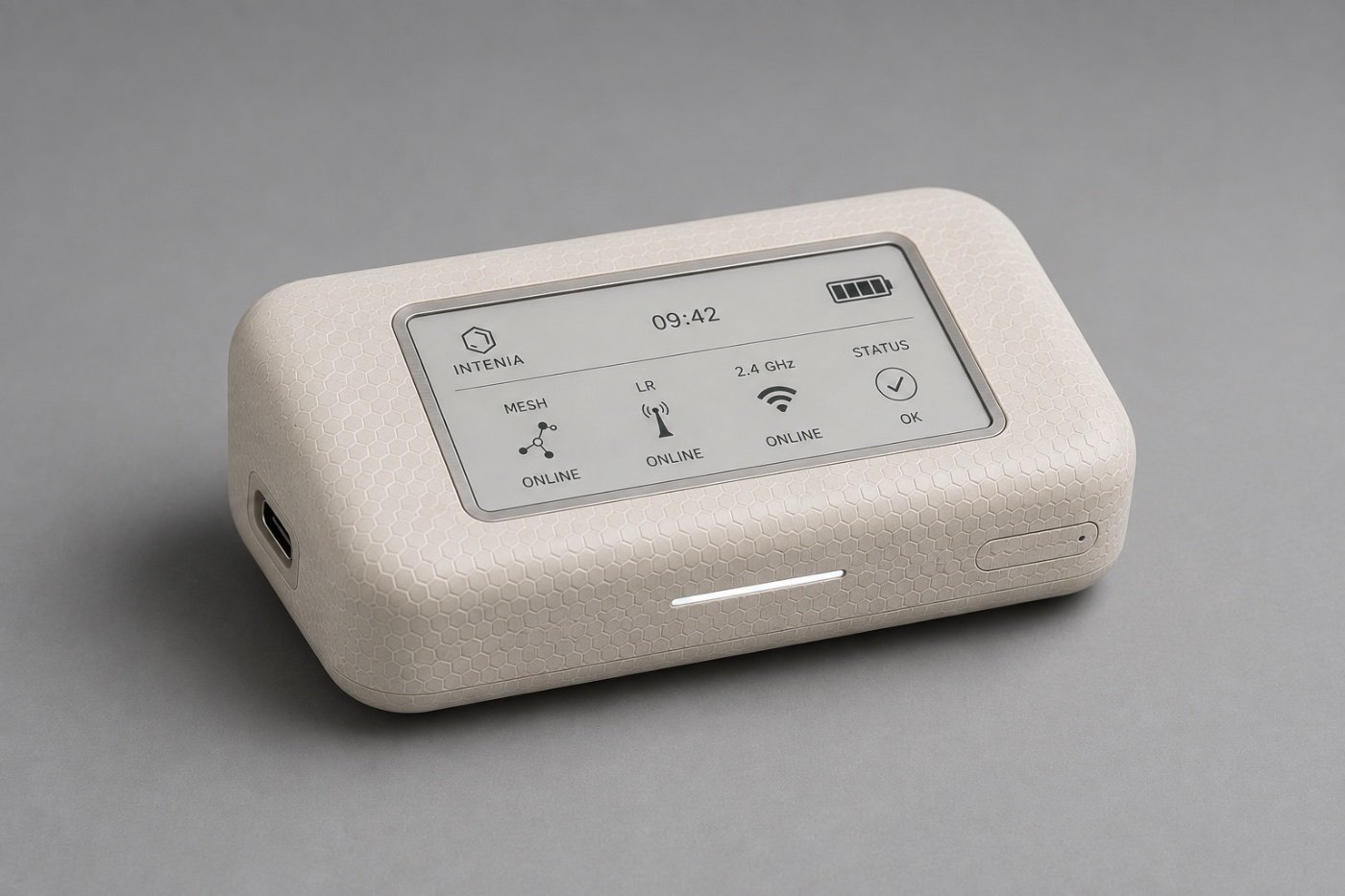
Every device proves who it is.
A mesh has no gatekeeper, so identity has to live in the device. Each device generates its own cryptographic identity and keeps the private key. No registry, no certificate authority, no account, no enrolment server.
Any node can verify who it is talking to, and a relay forwards traffic it cannot read. Authorisation sits at the endpoint — the device decides what it accepts and from whom.
There is nowhere else for it to go.
Data sovereignty here is a property of the architecture, not a policy. No cloud service holds your traffic. No vendor telemetry reports back to us. No account, no subscription, no third party in the path.
Traffic stays on your equipment, because the network has no destination outside it.
| Handset link | Encrypted, protected management frames |
|---|---|
| Mesh backbone | WPA3-SAE, key derived from a deployment passphrase |
| Application traffic | End-to-end, keys held on the device |
| Optional internet backhaul | Routed over Tor |
Handsets run verified boot with a locked bootloader and the cellular radio disabled.
The protocol layer is open and auditable. No vendor to trust, no black box.
Every failure mode is tested before it ships.
| CONDITION | TRAFFIC | CRITERION |
|---|---|---|
| Same gateway | Text | Under 1 s |
| Across the mesh | Text | Under 2 s |
| Across the mesh | Live voice | Under 300 ms, no dropout over 2 min |
| Across the mesh | Voice note | Under 5 s |
| Across the mesh | Photo | Under 10 s |
| Mesh link lost | Text over fallback | 10–60 s |
| Mesh link restored | Full rate | Under 2 s, within a minute |
| Out of range and back | Queued traffic | Delivers on reconnect |
| Gateway reboots mid-conversation | Nothing lost | Recovered in ~60 s |
Every kit is verified against all nine before it leaves the bench.
| Handset to gateway | Local |
|---|---|
| Gateway to gateway | 500 m – 1.5 km, line of sight |
| Long-range fallback | Text well beyond that |
| Airborne relay | Bridges dead ground at 100–120 m |
A relay payload light enough to fly turns a drone into a repeater over terrain that blocks a ground link.
A gateway draws 4–6 W. A 20 Ah bank runs it 12–18 hours.
Tracked vehicles survey, inject and report. Drones extend the survey and carry the relay. Both run on the same network and the same identity model.
Field reactors and sensor networks are designed to run on this layer, each with its own identity, each contributing data the others act on. That is why identity sits at the device rather than in a server.
The communications kit ships first, on its own.
State
| IN TESTING | Architecture complete, verification matrix passing, operator interface in development. |
|---|---|
| IN DEVELOPMENT | Ground vehicles and drones in small-scale testing. |