Fungal intelligence. Grown to spec.
Living systems consume contamination and build structures.
Our technology delivers them at industrial scale.
What we make
Bioprocess
Non-thermal sterilisation and controlled cultivation, scaled to project throughput. The platform under everything else.
Grown structures
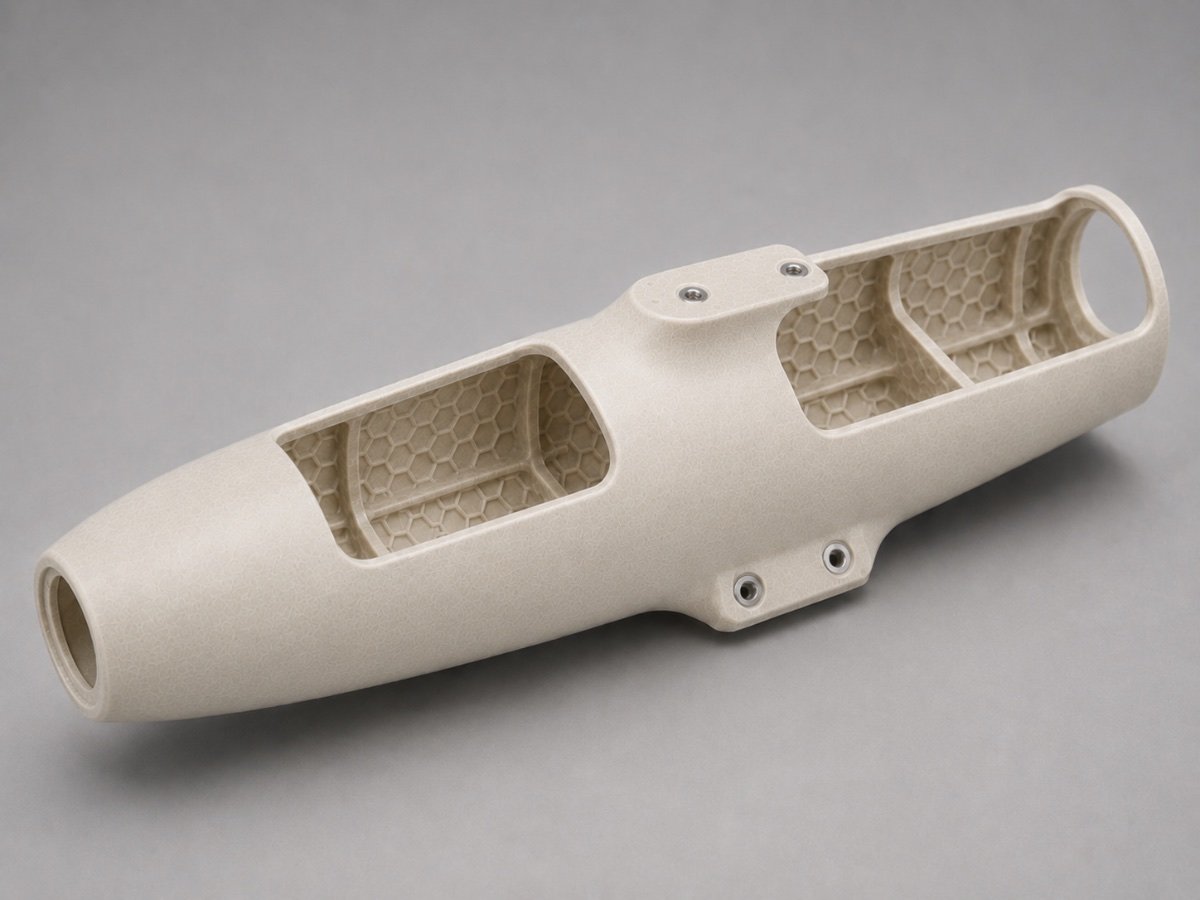
Airframes, panels and enclosures grown at our facility rather than laid up from imported prepreg.
Biocoatings
Seaweed-derived surface systems for flame performance, sealing, and controlled degradation.
Autonomous field systems
Tracked vehicles and drones that survey, inject and report without a crew on site.
Resilient communications
Off-grid mesh networking with no server, no cloud, and no cellular dependency.
One platform. Two outputs.
The first three steps are identical. What changes is where the culture goes.
| Vessel configuration | Scaled to project throughput |
|---|---|
| Sterilisation method | Non-thermal, proprietary |
| Process temperature | 2 °C |
| Control | PLC, continuous monitoring |
| Substrate | Domestic |
Where we are
We built a proprietary sterilisation and bioreactor platform to deliver mycelium at industrial scale. Every capability we offer runs on that proven system. Here is where each one stands, and what comes next.
Readiness levels, test summaries and production capacity available on request.
The antenna goes in the skin.
The material is a low-loss dielectric. The network needs antennas. A grown enclosure can carry its own radio, conformal in the wall rather than bolted through it, shielded where the electronics sit and open where the antenna does.
One part, one mould, one network — deployed by machines that work ground nobody is standing on.
Designed for purpose. Grown by zone.
Inoculate the mould and the colony binds across the whole form. Anything placed in it beforehand — conductive mesh, fibre reinforcement, mounting hardware — is incorporated as the part grows.
Put the avionics bay inside an RF mesh enclosure. Put the antenna in a second cavity with none. Conventional layup needs three components and two bonded joints. Ours is one part.
Substrate is hemp and industrial residue — straw, sawdust, corn husk, whatever the region already throws away. How we prepare it matters more than what it is, which means we source locally and control the outcome in the process.
Machines that run where there is no signal.
Centralised systems fail all at once. Lose the repeater and every radio on the site goes dark in the same second.
Ours has no centre. Every device holds its own identity, every node carries traffic for the rest, and nothing depends on any one of them. No server, no cloud, no telemetry. Data stays on your equipment.
Built for the remediation work, shipping on its own.
The ground is not uniform. Neither is the treatment.
The culture responds to what it meets — the contaminant profile, the substrate chemistry, the temperature. It lives where it works. We deliver it there.
Conventional remediation moves the problem. Soil is excavated, trucked and landfilled, or treated with chemicals that leave a second waste stream behind. Both get more expensive with every kilometre.
The system operates to −20°C surface temperature, which removes the seasonal shutdown that costs northern operations a restart every spring.